When Disc Pain Interrupts Daily Life
Back pain can make ordinary tasks difficult, especially when discomfort travels into an arm or leg or comes with numbness or tingling. When a disc presses on nearby nerves, spinal decompression may come up as one possible treatment, but the term covers different approaches, from nonsurgical traction to surgery.
Whether decompression has a role depends on what is causing the symptoms, a person’s health history, and the specific treatment being considered. At West Buffalo Chiropractic, care includes spinal decompression alongside adjustments, soft tissue therapy, and rehabilitation, with options considered in the context of personalized chiropractic care.
This article offers general information, not a diagnosis or a promise of relief. Persistent or worsening pain deserves professional assessment; a clinician can evaluate possible causes and discuss suitable options. Cleveland Clinic’s overview of spinal decompression explains that treatment choices depend on individual circumstances.
What Nonsurgical Decompression Involves
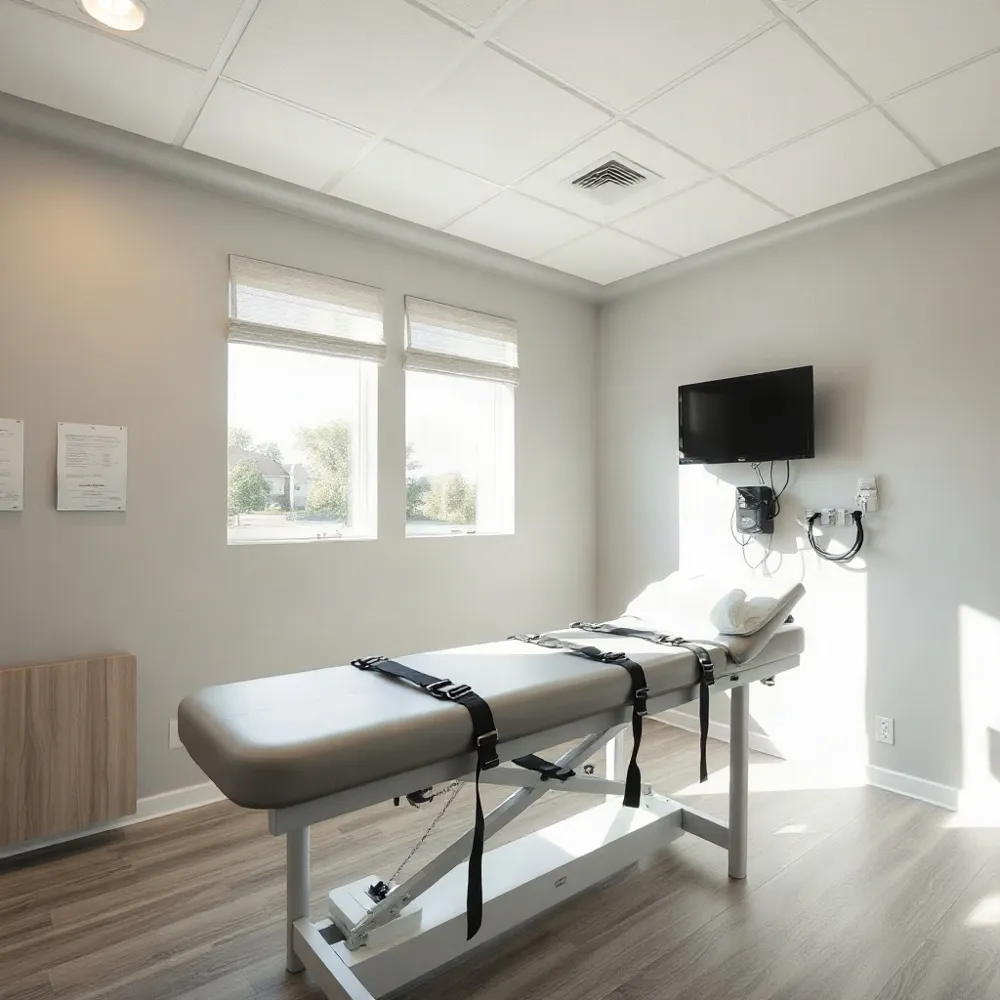 Nonsurgical spinal decompression is a form of motorized traction intended to gently stretch the spine and reduce pressure on discs and nearby nerves. It is different from surgical decompression, which removes disc material or bone to relieve pressure. The term covers distinct approaches, so it is worth asking a provider exactly what a proposed treatment involves. Cleveland Clinic’s overview describes both nonsurgical and surgical options.
In a typical nonsurgical session, the patient remains clothed, wears harnesses around the pelvis and trunk, and lies on a specialized table. A provider adjusts the settings, and the table applies controlled cycles of pulling and relaxation. WebMD’s treatment description notes that session length and treatment schedules can vary. Published descriptions include sessions of about 30 to 45 minutes, but that is not a universal schedule or a statement about West Buffalo Chiropractic’s protocol.
The treatment is based on the idea that changing pressure within a disc may affect pressure on nearby nerves. This proposed mechanism does not prove that a disc will retract, heal, or relieve symptoms. West Buffalo Chiropractic offers spinal decompression alongside services such as rehabilitation and soft tissue therapy, allowing care to be considered in a broader clinical context. An individual assessment should come first, with a discussion of possible benefits, limitations, and alternatives.
Disc Conditions and Possible Relief
Bulging, worn, or herniated discs can contribute to pressure on nearby spinal nerves. Depending on the cause and location, nerve compression may be associated with back pain, numbness, tingling, or symptoms that travel into an arm or leg, including sciatica. These symptoms can have other causes too, so they do not by themselves confirm a disc problem. Cleveland Clinic’s overview of spinal decompression describes these disc-related conditions and symptoms.
Can spinal decompression therapy help with a herniated or bulging disc?
It may help some people, but research does not show that it works for everyone or repairs every disc problem. A 2022 randomized study of adults with subacute, MRI-confirmed lumbar herniation found lower leg-pain scores in the active-treatment group at one assessment, along with better disability scores at two and three months and a greater average reduction in MRI-measured herniation size than in the sham group. The study did not find a significant between-group advantage for lower-back pain. The trial report included only 43 of 60 randomized participants in its final analysis, and more people dropped out of the sham group.
Those results apply to one treatment protocol and a limited follow-up period, not to every device, patient, or type of back pain. A 2007 review found that the earlier research was limited and had important methodological weaknesses, underscoring the uncertainty around effectiveness and comparisons with other care. The review also cautioned against treating findings from one system as proof for others.
What are the potential benefits and downsides?
Some patients may experience less radiating pain or improved function, sometimes alongside other conservative care. However, decompression is not a proven way to restore every disc, prevent surgery, or replace medical evaluation. West Buffalo Chiropractic includes spinal decompression among its services, alongside spinal adjustments, soft tissue therapy, and rehabilitation. A clinician should consider your symptoms and health history before recommending treatment; West Buffalo Chiropractic’s whole-person approach makes those individual circumstances relevant to the care discussion.
Safety and Individual Suitability
 Safety depends on the person, the cause of symptoms, and the treatment used. Some people may experience temporary soreness, stiffness, discomfort, or a flare in symptoms. Stop treatment and contact your provider if pain or other symptoms worsen or persist.
Is spinal decompression therapy safe, and what side effects or risks should patients know about?
A small study of nonsurgical decompression reported no related adverse events among the participants included in its analysis, but its limited size and follow-up cannot establish that treatment is risk-free for everyone. An earlier review also described a single case report in which a disc protrusion worsened and severe pain required urgent surgery. That case does not show how often such an outcome occurs, but it is a reason not to dismiss worsening symptoms. The 2022 study and the literature review both have limitations that should inform discussions about safety.
Seek urgent medical care for new or rapidly worsening leg weakness, numbness around the groin, or loss of bladder or bowel control. These symptoms need prompt medical attention rather than a routine treatment adjustment.
Who should avoid spinal decompression therapy?
Decompression may be unsuitable for some people who are pregnant or have a spinal fracture, instability, osteoporosis, prior spinal fusion or surgery, spinal implants, infection, or a tumor. Blood-thinner use and other health concerns also warrant review. This is not a checklist for deciding on your own: a qualified clinician should consider your health history, symptoms, and relevant imaging. Cleveland Clinic’s overview also emphasizes that treatment choices depend on individual health and injury factors.
At West Buffalo Chiropractic, Dr. Francisco Vaquero, D.C., offers spinal decompression alongside spinal adjustments, soft tissue therapy, and rehabilitation. The clinic’s whole-person approach provides context for discussing care, but suitability still calls for an individual clinical assessment.
Treatment Choices and Realistic Expectations
For persistent back pain, care often starts with less invasive options. A clinician considers the person’s health history and the severity of the problem when recommending a plan, and may discuss treatment choices for spinal decompression such as physical therapy, chiropractic care, acupuncture, traction, or TENS.
Physical therapy may include stretches, safer lifting techniques, and exercises to support movement and function. Chiropractic adjustments are a separate complementary option, not proof that a disc has been decompressed. At West Buffalo Chiropractic, care includes spinal adjustments, rehabilitation, soft tissue therapy, and spinal decompression, allowing a provider to consider different services in the context of an individual’s needs.
Nonsurgical decompression uses traction, while surgical procedures act directly on structures that may be pressing on nerves. For example, a diskectomy removes part of a disc, and other operations may create more room for spinal nerves. Surgery can relieve pain, but it carries risks and may not correct every degenerative problem; symptoms can return.
How long does spinal decompression therapy take to work, and how long might its effects last?
There is no dependable timeline for improvement or established duration of benefit. Treatment may involve multiple sessions, but schedules and responses vary. Disc symptoms can also improve naturally, so a change during treatment does not show that decompression alone caused it. A provider should review symptoms and function over time and discuss whether the plan is helping.
Is spinal decompression a permanent fix for back pain or a disc problem?
No permanent result is guaranteed. Decompression may ease symptoms for some people, but it does not necessarily reverse disc changes or prevent pain from returning. Rehabilitation, exercise, and activity adjustments may form part of a broader plan. West Buffalo Chiropractic offers rehabilitation alongside other services, and patients can discuss realistic expectations and alternatives with a healthcare provider.
Movement, Exercise, and Home Care
Gentle movement and clinician-guided exercise may support mobility, strength, and symptom management, but they do not reliably decompress a disc or replace an assessment. Physical therapy may include tailored stretches, safer movement techniques, and exercises suited to the person’s condition, as Cleveland Clinic guidance on spinal decompression explains.
There is no universal exercise list for a herniated disc. Depending on symptoms and diagnosis, a clinician may suggest walking, gentle stretches, or core-stabilization work. At West Buffalo Chiropractic, rehabilitation is among the services offered, so an exercise plan can be considered alongside the clinic’s broader personalized care.
Pay attention to how your body responds. Heavy lifting, repeated deep forward bending, twisting under load, or high-impact activity may aggravate symptoms for some people, but no movement is unsuitable for everyone. Stop or modify an activity if it increases pain, numbness, tingling, or weakness, and ask a healthcare professional about alternatives that fit your situation.
Costs, Coverage, and Clinic Conversations
 How much does nonsurgical spinal decompression therapy cost, and is it covered by insurance? The available sources do not establish a standard price or a general coverage rule. Your total may depend on the clinic, the recommended number of visits, the initial evaluation, and whether other services are included.
Before beginning, ask your insurer to confirm benefits, exclusions, visit limits, and expected out-of-pocket costs. Request a written, itemized estimate from the clinic for the full recommended plan, not just the price of one visit. Coverage can vary by policy, so do not assume a service will be reimbursed.
At West Buffalo Chiropractic in Buffalo, spinal decompression is one of the services offered as part of personalized care led by Dr. Francisco Vaquero, D.C. The clinic describes CareCredit as a financing option and offers online appointment booking. Ask the clinic directly about available payment options and any terms; these details do not establish insurance coverage or eligibility.
An initial conversation can clarify both the clinical reasoning and the likely expense. Ask what diagnosis is suspected, why decompression is being considered, what alternatives are available, and how progress will be measured. Also ask what symptoms or findings would prompt stopping treatment, and what the complete expected cost would be. A clinician can explain how the plan relates to your individual health history and needs.
Choose Care With Clear Expectations
Nonsurgical decompression may be considered for some people with disc-related symptoms, but research does not establish that it will help everyone or provide lasting relief. A small 2022 trial found some improvements in leg pain and function, but not a clear advantage for lower-back pain over the comparison treatment, and its authors noted important limits to the findings (study of nonsurgical spinal decompression).
If pain persists or limits daily activities, ask a qualified healthcare provider to assess its cause and compare suitable options. Treatment should reflect your health history and goals, not advertised success claims or an assumption that decompression will permanently fix a disc problem. The Cleveland Clinic’s overview of spinal decompression also advises discussing individual expectations with a provider.
At West Buffalo Chiropractic, Dr. Francisco Vaquero, D.C., provides personalized chiropractic care that includes spinal decompression, adjustments, soft tissue therapy, and rehabilitation. A conversation about your symptoms and questions can help clarify whether an evaluation or another care option is appropriate, without promising a particular result.